Bleap
NOPHASE JUCE SFX instrument built for fast risers, impacts, sweeps, and transitional textures.
- Playable prototype
- Plugin
- VST3 / AU / Standalone
- JUCE / C++
Summary
Bleap is a purpose-built AU/VST plugin for quick creation of risers, impacts, noise sweeps, downlifters, whooshes, and transition FX. It is aimed at speed-to-result more than open-ended synthesis depth.
Snapshot
- Status: playable prototype
- Format: JUCE sound-design plugin
- Framework: JUCE / C++
- Targets: VST3, AU, and Standalone
- Focus: fast production SFX generation instead of deep general-purpose synthesis
What It Is
- Combines oscillator and noise sources for transition-heavy sound design
- Uses a streamlined modulation workflow instead of a deep matrix
- Includes a reorderable FX section for destruction, space, motion, and stereo width
- Supports sync or free timing depending on whether the patch needs DAW lock or looser gesture timing
- Keeps randomization central to the workflow with full random and wiggle-style nearby variation
Current Direction
Bleap is less about building a full synth patch from first principles and more about reaching usable cinematic or production FX quickly. The UI, modulation slots, and onboard FX all push toward one-shot gestures and transitional sounds rather than traditional keyboard-instrument programming.
Gallery
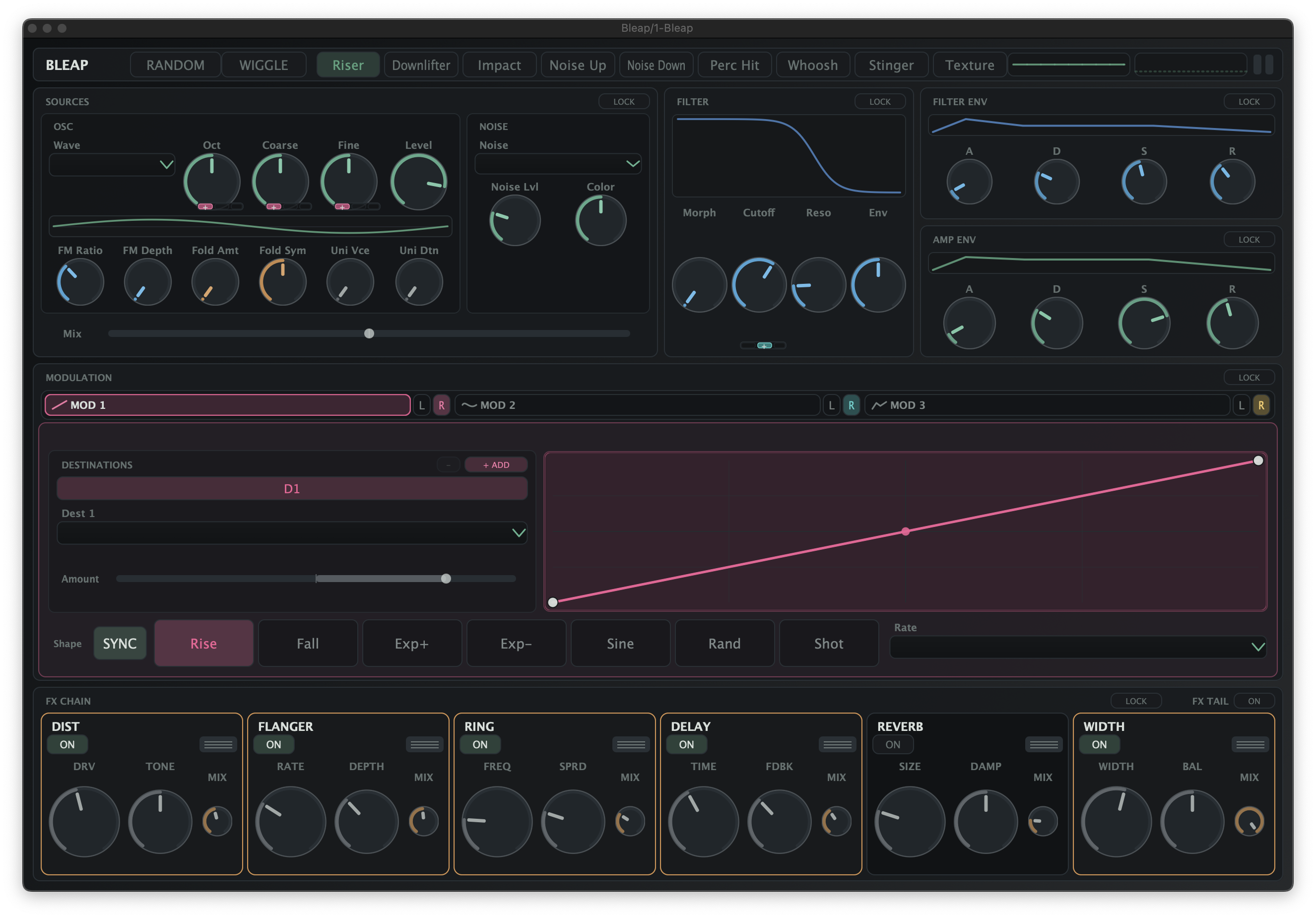
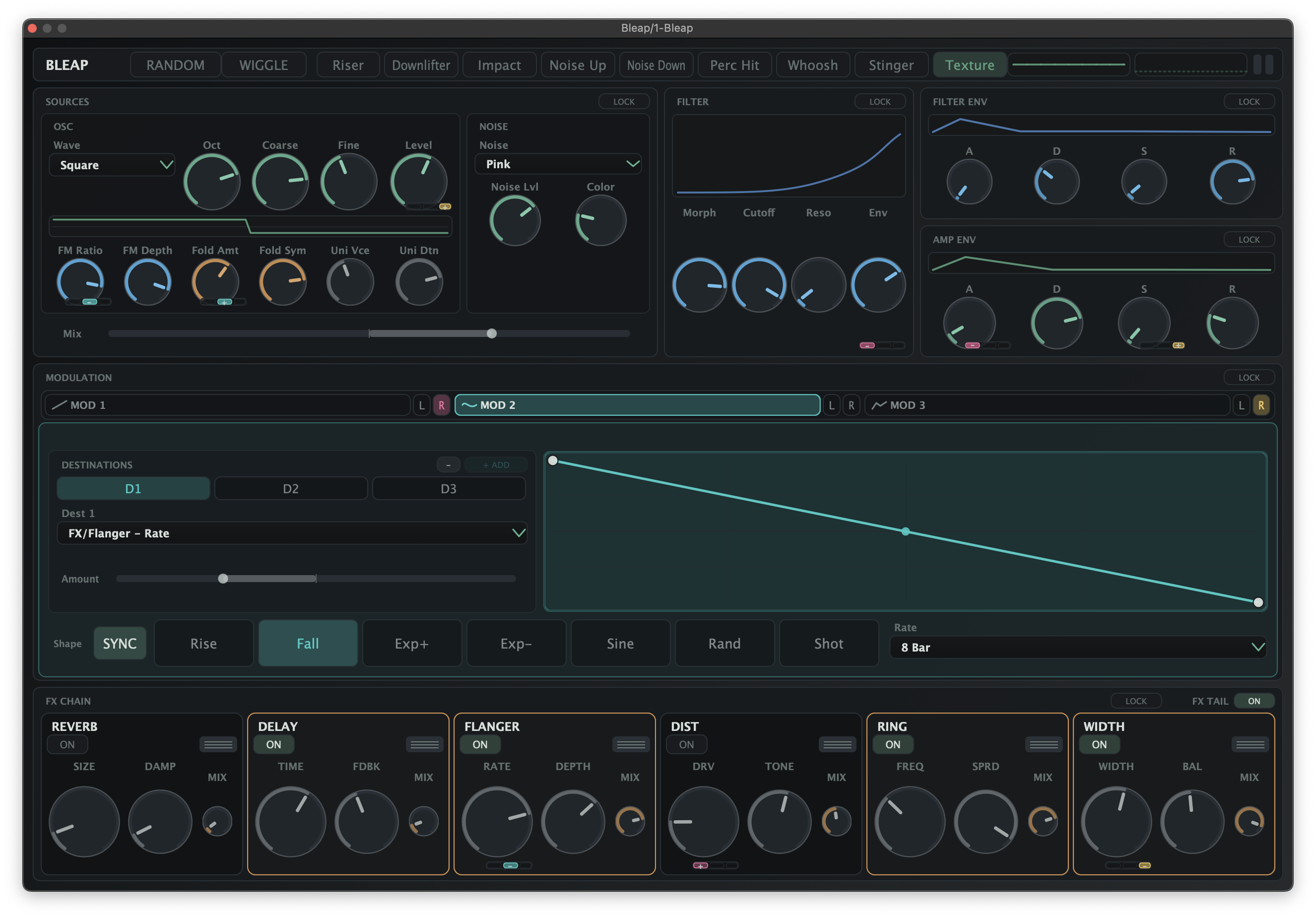
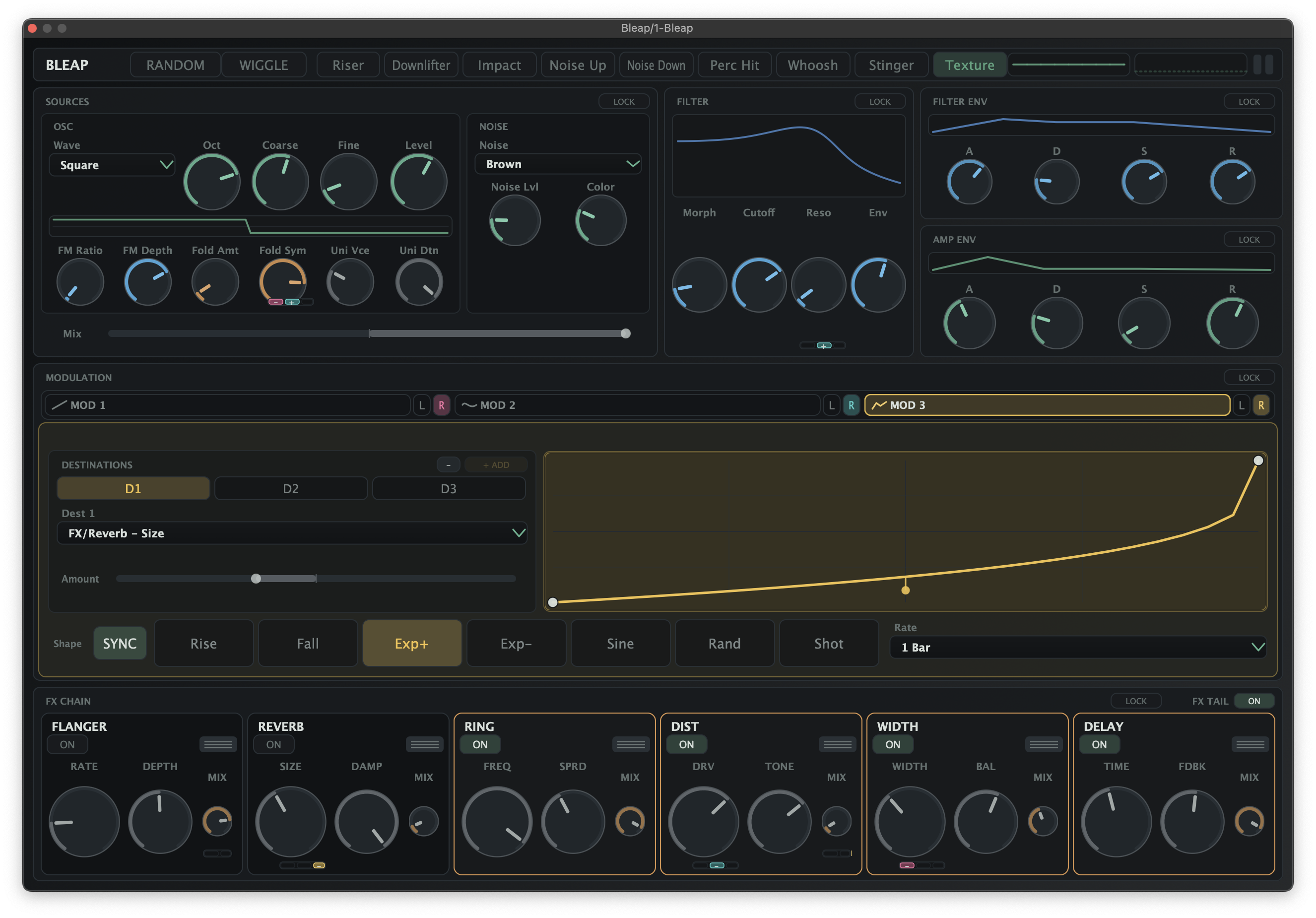
Technical Docs
Implementation details, architecture, and code excerpts for Bleap.
Architecture
Bleap is split into a few practical layers:
Source/PluginProcessor.*: JUCE host integration, parameter layout, MIDI event handling, scope/meter collection, stateSource/BleapEngine.*: synthesis, modulation routing, envelopes, filter, and FX processingSource/PluginEditor.*: custom UI, modulation curve editing, randomization, and display logic
That split keeps the processor focused on host and state responsibilities while the engine handles the actual sound generation.
Key Systems
- One oscillator with
Sine,Saw,Square, andTriangle - Noise source with
White,Pink, andBrown - Source blend, FM ratio/depth, and wavefold controls
- Filter morph, cutoff, resonance, and drive
- Separate amp and filter ADSR sections
- Three modulation slots with live DSP routing
- Editable modulation curves with add/remove point workflow
- Random and wiggle actions with section locks
- Reorderable FX chain with distortion, flanger, ring mod, delay, reverb, and width
- Header metering, oscilloscope, and lightweight spectrum display
At a high level, the signal path is:
Oscillator + Noise -> Mixer -> Filter -> Amp/Env -> FX -> Output
Implementation Notes
Bleap processes MIDI events inside the audio block and renders each region between events through the engine:
1
2
3
4
5
6
7
8
9
for (const auto metadata : midiMessages)
{
    const auto eventSample = juce::jlimit(0, buffer.getNumSamples(), metadata.samplePosition);
    engine.render(buffer, blockPosition, eventSample - blockPosition, params, transport);
    processMidiEvent(metadata.getMessage(), params, transport);
    blockPosition = eventSample;
}

engine.render(buffer, blockPosition, buffer.getNumSamples() - blockPosition, params, transport);
That is a good fit for one-shot SFX behavior because it keeps note triggers and render state aligned without burying note logic inside the UI.
The runtime parameter struct is broad because Bleap exposes most of the sound design path directly:
1
2
3
4
5
6
7
8
9
10
11
12
struct RuntimeParameters
{
    Waveform waveform = Waveform::saw;
    float sourceMix = 0.0f;
    float fmRatio = 1.0f;
    float fmDepth = 0.0f;
    float foldAmount = 0.0f;
    NoiseType noiseType = NoiseType::white;
    float filterCutoffHz = 4000.0f;
    std::array<ModSlotParameters, 3> modSlots {};
    std::array<int, 6> fxOrder { 0, 1, 2, 3, 4, 5 };
};
This is one of Bleap’s strengths: the plugin is not hiding its core motion and tone-shaping systems behind a tiny macro surface. The important sound-design decisions are first-class.
Bleap uses three modulation slots, each with a shape, timing mode, editable curve data, and up to three routes. The engine advances each slot every sample and applies the routed output to named targets.
1
2
3
4
5
6
7
8
9
10
11
12
13
14
for (size_t slotIndex = 0; slotIndex < modulationStates.size(); ++slotIndex)
{
    const auto modulationValue = modulationStates[slotIndex].advance(random);
    for (const auto& route : params.modSlots[slotIndex].routes)
    {
        const auto routed = modulationValue * route.amount;
        switch (route.target)
        {
            case ModTarget::pitch:
                pitchModSemitones += routed * 24.0f;
                break;
            case ModTarget::filterCutoff:
                filterModulation += routed * 3.5f;
                break;
This avoids a huge generic matrix while still covering the destinations that matter for SFX work.
The curve system is also richer than a simple LFO shape dropdown. Each slot can store a custom point curve with per-segment bending:
1
2
3
4
5
6
7
struct LfoCurveData
{
    bool useCustom = false;
    int pointCount = 2;
    std::array<LfoCurvePoint, maxLfoCurvePoints> points {};
    std::array<float, maxLfoCurvePoints - 1> segmentCurves {};
};
That is a strong design choice for transition FX, where envelope shape often matters more than oscillator complexity.
At the source layer, Bleap combines a pitched oscillator, FM, wavefolding, and a dedicated noise engine:
1
2
auto oscillatorSample = renderOscillatorSample(params.waveform, oscillatorFrequency);
const auto noiseSample = renderNoiseSample(params.noiseType, effectiveNoiseTilt);
The oscillator section supports classic shapes, while the noise path can switch between white, pink, and brown behavior. That mix is exactly what makes the instrument useful for risers, impacts, and textured sweeps instead of only pitched synth lines.
The engine owns the FX chain directly and applies it after source and envelope processing:
1
processFxChain(leftOutput, rightOutput, fxParams);
The current FX design includes distortion, flanger, ring modulation, delay, reverb, and width, with reorder support in the parameter model. There is also a tail-bypass path so the engine can continue generating FX-only output after the main note has ended when needed.
Current Focus
unisonVoicesandunisonDetuneare surfaced in UI/state but not yet active in DSP- The macro control is still a simple global tonal push, not a full assignment system
- Preset browsing and preset management are not finished yet
- Host-reported tail length does not fully reflect the internal FX-tail behavior