Destroytion
NOPHASE JUCE VST3 distortion plugin with working multi-stage DSP, host-synced random modulation, and a custom performance UI.
- Active prototype
- Plugin
- VST3 effect
- JUCE / C++
Summary
Destroytion is a native JUCE stereo distortion plugin focused on animated destruction, rhythmic motion, and aggressive but playable timbral control. The prototype is already running as a real VST3 with custom DSP and a purpose-built editor, not just a concept patch. Under the hood it pairs tempo-synced random modulation with a multi-stage nonlinear DSP path.
Snapshot
- Status: prototype in active iteration (active JUCE prototype)
- Format: native JUCE stereo VST3 effect
- Stack: JUCE and C++
- Current editor size:
1080 x 572 - Focus: animated destruction with rhythmic motion and a strong musical middle
What It Is
- HEAT
- EDGE
- FRACTURE
- FLUX
- FOCUS
- BLEND
Those six strips define the main sound-shaping identity of the plugin. The project is built around tempo-synced random modulation, custom per-channel DSP, and a performance-oriented editor rather than a generic distortion layout.
Current Direction
- Preserve a musical mid-range before extreme breakup
- Improve voicing at high settings
- Continue UI clarity and real-time playability improvements
Gallery
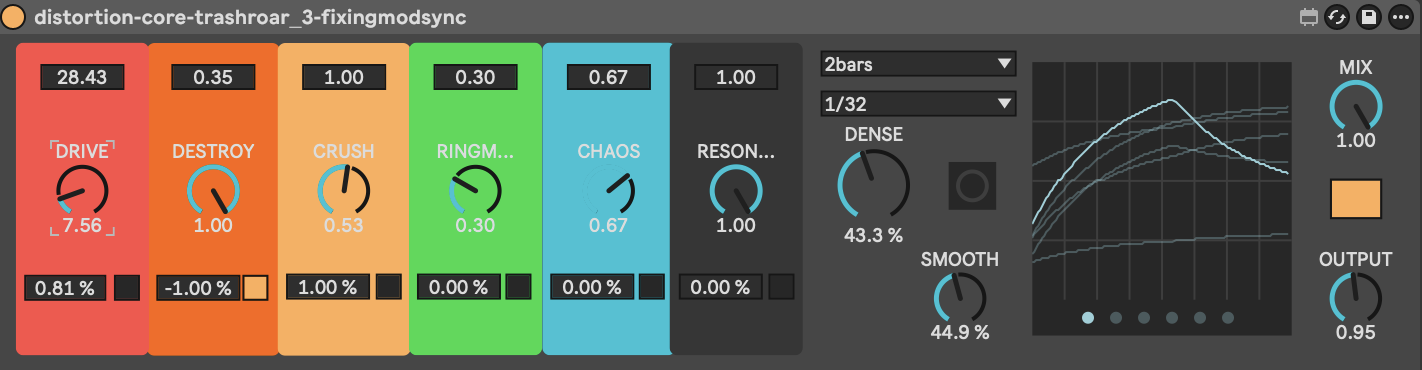
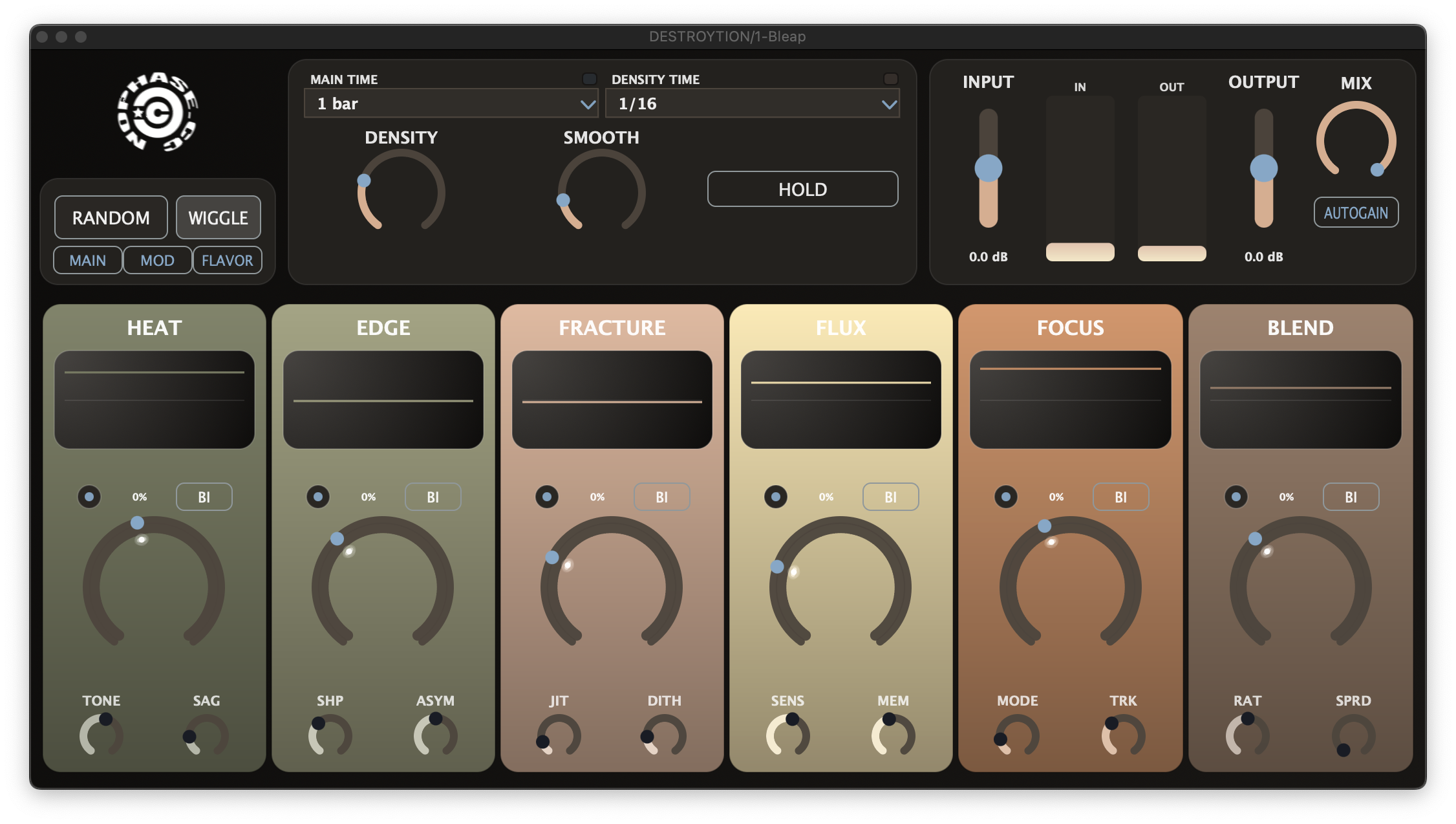
Technical Docs
Implementation details, architecture, and code excerpts for Destroytion.
Architecture
The working plugin is split into four main runtime pieces:
Source/PluginProcessor.*: host integration, parameter layout, audio block loop, metering, state save/restoreSource/DestroytionParamResolver.*: fast parameter reads from APVTS and final modulation applicationSource/ccModulator.*: transport sync, trigger timing, random target generation, smoothingSource/DestroytionChannel.*: per-channel DSP state and distortion stages
That structure keeps the audio callback readable. The processor coordinates the system, while the modulation and DSP logic live in focused modules.
Strip Roles
HEAT: drive and saturation bodyEDGE: fold and destruction intensityFRACTURE: crush, hold, jitter, and dither characterFLUX: ringmod and chaos motionFOCUS: filter tone and tracking behaviorBLEND: body versus texture recombination
At a high level, the audio path is:
Transport -> Modulation -> Parameter Resolve -> Input Trim -> Per-Channel DSP -> Autogain -> Mix -> Output
Implementation Notes
Each sample follows the same block-processing rhythm:
1
2
3
4
5
6
7
8
9
10
11
12
const auto stepData = paramResolver.readStepData();

ccModulator::StepInput modInput;
modInput.mainRateIndex = stepData.mainRateIndex;
modInput.densityRateIndex = stepData.densityRateIndex;
modInput.densityAmount = stepData.densityAmount;
modInput.smooth = stepData.smooth;
modInput.holdMod = stepData.holdMod;
modulator.processSample(modInput);

const DestroytionParamSet p =
    paramResolver.buildModulatedParams(stepData, modulator.getCurrentValues());
After modulation resolves, the processor trims input, runs the left and right channels independently, estimates loudness, and applies optional autogain:
1
2
3
4
5
6
const float wetL = leftChannel.process(dryLeft, p, ringPhase, 0.0f, sr, rng);
const float wetR = rightChannel.process(dryRight, p, ringPhase, 0.25f, sr, rng);

const float gainComp = clipf(inputLevel / outputLevel, 0.25f, 4.0f);
const float targetGain = p.autogain ? gainComp : 1.0f;
smoothGain = smoothGain * 0.9995f + targetGain * 0.0005f;
That gain smoothing is important because the effect can move through radically different nonlinear states very quickly.
The modulation system is host-aware. If the DAW provides PPQ position, the plugin uses it. If not, it falls back to free-running phase accumulation.
1
2
3
4
5
6
7
8
9
if (hasPpqSync)
{
    ppq = ppqStart + static_cast<double>(sampleIndexInBlock) * ppqPerSample;
}
else
{
    ppq = freeRunPpq;
    freeRunPpq += ppqPerSample;
}
Two trigger layers drive the movement:
MAIN TIMEproduces guaranteed structureDENSITY TIMEproduces optional extra events
When a trigger fires, the modulator generates six new random targets, one for each major strip. SMOOTH then turns abrupt jumps into slewed motion:
1
2
3
4
const float fastToSlow = std::pow(smoothNorm, 3.0f);
const float tauMs = juce::jmap(fastToSlow, 4.0f, 3200.0f);
const float tauSamples = juce::jmax(1.0f, (tauMs * 0.001f) * static_cast<float>(sr));
const float slew = 1.0f - std::exp(-1.0f / tauSamples);
This is one of the core ideas in Destroytion: motion is not a side feature, it is part of the sound design model itself.
The modulator only outputs six normalized values. DestroytionParamResolver translates those into actual strip values while respecting parameter ranges, user modulation amount, and bipolar versus unipolar polarity.
1
2
3
4
5
6
7
8
9
if (stepData.unipolar[i])
    offset = modValues[i] * modRange;
else
    offset = ((modValues[i] * 2.0f) - 1.0f) * modRange;

if (modAmount < 0.0f)
    offset = -offset;

*values[i] = clipf(*values[i] + offset, minVals[i], maxVals[i]);
That keeps the UI expressive without letting modulation push parameters into nonsense states.
The per-channel DSP path is where the plugin gets its voice.
HEAT
HEAT is more than simple gain. It applies input-dependent sag and blends different saturation shapes:
1
2
3
4
5
const float heatDrive = driveToGain(p.heat);
const float sagScale = 1.0f / (1.0f + p.driveSag * 1.8f * c.driveEnv);
const float pre = signal * heatDrive * sagScale;
const float smoothSat = softClip(pre * 0.68f) + 0.22f * softClip(pre * 0.2f);
const float denseSat = softClip((pre + colorAsym) * 1.06f) - softClip(colorAsym * 1.06f) * 0.58f;
EDGE
EDGE pushes the signal into a controllable folding stage rather than just adding more generic clipping:
1
2
3
const float edgeFolded = foldBlend(bodyBase + edgeBias, p.edge * 0.9f, edgeShape) - edgeBias * 0.2f;
const float edgeMix = std::pow(p.edge, 0.8f);
const float body = juce::jmap(edgeMix, bodyBase, edgeFolded);
FRACTURE
FRACTURE combines bit reduction, sample-and-hold timing, jitter, and dither:
1
2
3
4
5
6
7
8
if (--c.crushCounter <= 0)
{
    const int baseHold = 1 + juce::roundToInt(rateNorm * 70.0f);
    const float jitter = (rng.nextFloat() * 2.0f - 1.0f) * jitterRange;
    c.crushCounter = juce::jmax(1, baseHold + juce::roundToInt(jitter));
    const float dither = (rng.nextFloat() * 2.0f - 1.0f) * (p.crushDither / bitSteps);
    c.crushHold = std::floor((texture + dither) * bitSteps + 0.5f) / bitSteps;
}
FLUX
FLUX moves between amplitude modulation, ring modulation, and chaotic feedback-influenced behavior:
1
2
3
4
const float ratio = ratioFromNorm(p.ringRatio + (rng.nextFloat() - 0.5f) * 0.08f * fluxMotion);
const float carrierHz = (26.0f + std::pow(p.flux, 1.05f) * 160.0f) * ratio;
const float ringOsc = std::sin(phase * juce::MathConstants<float>::twoPi);
const float ringBlend = juce::jmap(p.flux, am, ring);
FOCUS And BLEND
FOCUS uses a simple state-variable style filter to move between low-pass, band-pass, and high-pass regions, while BLEND recombines body and texture energy before the final output stage.
1
2
3
const float hp = combined - c.svfLp - damp * c.svfBp;
c.svfBp += f * hp;
c.svfLp += f * c.svfBp;
Current Focus
- Keep animated destruction behavior musically usable
- Preserve a strong mid-range before extreme breakup
- Improve real-time modulation clarity for performance